Finding 3D Models on MyMiniFactory
MyMiniFactory is the curated repository — every upload is checked before it goes live — and the natural home of tabletop miniatures and museum scans. Here is how to find the good files and what to know before printing them.
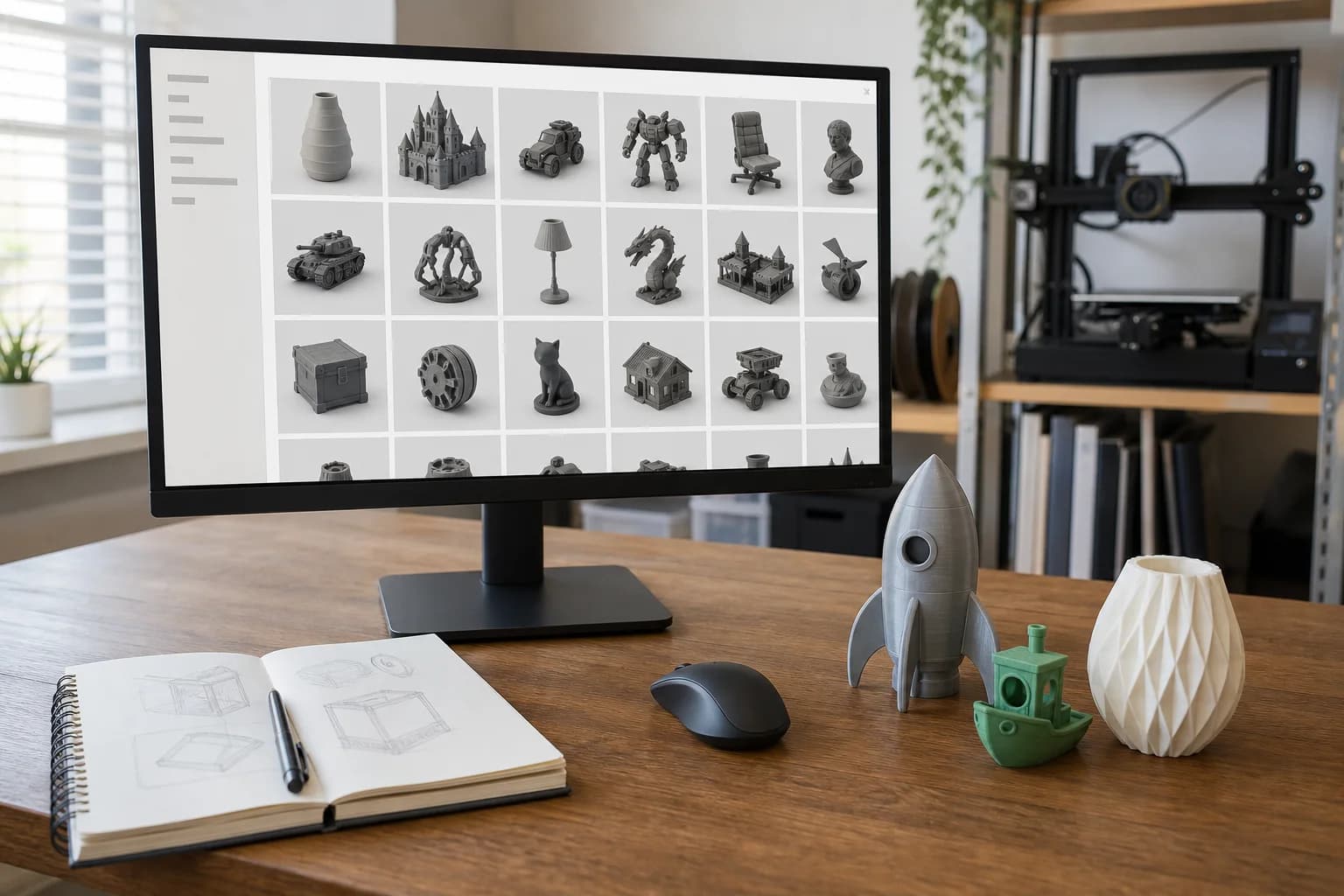
MyMiniFactory is a London-based model repository with one habit that sets it apart: every upload is checked for printability before it goes live, and models are test-printed as part of that vetting. Where the big open repositories will host anything with a .stl extension, MyMiniFactory acts as a filter. That makes it the natural first stop for tabletop miniatures, busts, terrain and display sculpture — and, to be plain about it, the wrong stop for engineering parts. If you want a bracket, read our GrabCAD guide instead.
What it is genuinely good at
Curation. The download-and-discover misery of open repositories is finding out a model was never printable after you have paid for it to fail. Because MyMiniFactory checks what goes up, a file from there almost always slices without drama — closed mesh, sane wall thicknesses, no surprise non-manifold soup. That alone is worth the visit.
Tabletop. MyMiniFactory has become one of the main homes of professional miniature sculptors. Dungeon crawlers, wargame proxies, terrain sets, monstrous things with far too many teeth — the depth here is genuinely impressive, and much of it is sculpted to a standard the free-for-all sites rarely reach.
Scan the World. A long-running community project that 3D-scans sculptures and artefacts in museums and public spaces and shares the results freely. Classical statuary, busts of composers, architectural fragments — a free, open museum you can print from. For anyone furnishing a bookshelf or a classroom, it is a quiet treasure.
Designers get paid on the platform. Sculptors sell files through their own stores, run crowdfunding campaigns for big releases, and operate "tribes" — subscription communities where a monthly fee gets you a stream of new releases and members-only models. It is the reason the professional sculptors stay: the platform gives them an income rather than just exposure.
Where it is weaker
Be honest about what it is not. Functional and mechanical models are thin on the ground — you will find some phone stands and hooks, but nobody goes to MyMiniFactory for a DIN rail clip. Almost everything is STL: sculpted mesh, not editable CAD, so resizing is easy but redesigning is not. And a lot of the best tabletop work sits behind a price tag or a tribe subscription. That is fair — sculpting is work — but browse with the free/paid filter set deliberately rather than wondering why the front page keeps asking for money.
How to search it well
- Filter free versus paid first. The toggle is in the search filters and it changes the character of the results completely.
- Follow the sculptor, not the search box. When one model impresses you, open the designer's profile. Tabletop designers work in coherent ranges, and their store page or tribe is usually where the rest of the warband lives.
- Use collections. Curated collections group compatible models — a full dungeon set, a themed army — far better than keyword search does.
- Look for photographs of actual prints. Listings show real prints as well as renders. A model photographed in grey resin on somebody's desk has been through a printer; a listing that is all renders tells you less.
- In Scan the World, search by artist or museum rather than subject — "Rodin" gets you further than "statue".
What to know before printing miniatures
Most miniatures on MyMiniFactory are sculpted with resin printing in mind, and that has practical consequences at the standard 28–32 mm gaming scale:
- Detail softens on FDM. A 0.4 mm nozzle cannot reproduce chainmail texture the way a resin printer can. FDM handles the same file perfectly well at 2–3× scale — a 28 mm sculpt printed as a 150 mm display piece often looks superb.
- Thin features are fragile. Spears, sword blades and trailing cloth that survive in resin will snap in FDM plastic at gaming scale. Terrain, busts and larger monsters are the FDM-friendly end of the catalogue.
- Pre-supported files are for resin. Many paid miniatures ship in two versions: plain and pre-supported. The pre-supported one has resin support trees already modelled in — for FDM you want the clean, unsupported version and let the slicer do its own supports.
- Scan the World meshes are heavy. Real-world scans run to millions of triangles and occasionally carry scanning artefacts. Most print fine as-is; if one misbehaves, the fixes in why your STL might not be printable apply.
Licensing, plainly
Every object page states its licence, and they vary:
- Free models are typically under a Creative Commons variant. Attribution (CC BY) is generous; the NC flavours mean non-commercial; ND means print it as-is, no remixing. Scan the World pieces are generally under open licences, but check the specific object.
- Paid models are sold for personal use by default: you may print them for yourself, but not resell the file or sell prints. Some creators sell separate commercial licences for people who want to sell physical prints — the object page or the creator's profile says so.
- Having a service print it for you sits comfortably within personal use in most creators' terms — you own the file, the print is for you, and nobody else keeps a copy. Selling those prints on is a different matter entirely and needs the creator's commercial licence.
That is practical guidance, not legal advice: the licence on the object page is the document that counts, and creators do differ.
From download to printed part
Download the file (the unsupported version, if there is a choice), decide the finished size — for miniatures and statues, the overall height you want is the single most useful thing you can tell us — and upload the STL. We check every file before quoting and will flag anything too fine to survive FDM at your chosen scale, and suggest a scale or material that will work. Materials and how pricing works cover the rest, and if you are still deciding where to hunt for files, the full guide to finding printable models compares the other platforms.
FAQ
Can you print a paid MyMiniFactory file I have bought?
Yes, for your own use — you bought the licence, the print is yours, and we do not keep or reuse your file. If you intend to sell the prints, buy the creator's commercial licence first.
Will a 28 mm miniature printed in FDM look like the listing photos?
Usually not — those photos are almost always resin prints. FDM at that scale loses fine surface detail and thin parts become fragile. Scale it up, or pick terrain and larger models, and FDM does the job well.
Is Scan the World free to use?
Yes. The scans are shared under open licences, generally requiring attribution. Check the individual object page, as terms vary piece by piece.
What file version should I send you — supported or unsupported?
Unsupported. Pre-supported files have resin support structures modelled into the mesh, which are wrong for FDM. Send the clean model and we handle orientation and supports.
Models that show this in practice
Open-source designs from our print library. Each one has a full material and quantity price breakdown.
Gusseted Shelf Bracket (small)
Drawer Organiser Tray
L-Bracket (heavy-duty)
L-Bracket (large)
These are open-source example designs (CC0) we publish to show what the process suits and what it costs — not a record of past jobs. Prices shown are examples in PLA.
Get a 3D print estimate
Upload your file or describe the part. We review printability before confirming anything.
Services covering this
Related guides
Where to Find 3D Models to Print
You don't need CAD skills to get a part printed — millions of ready-made models are free to download. Where to look, how to judge what you find, and what the licence small print actually means.
GrabCAD and Other Sources of Engineering CAD Models
For functional parts, hunt where the engineers share — GrabCAD Community, TraceParts and 3D ContentCentral — and take the STEP file over the STL every time. Here is why, and what to watch for.
Finding 3D Models on Thingiverse
Thingiverse is the oldest and biggest free model archive — brilliant for obscure parts, cluttered with abandoned files. How to dig out the good stuff.