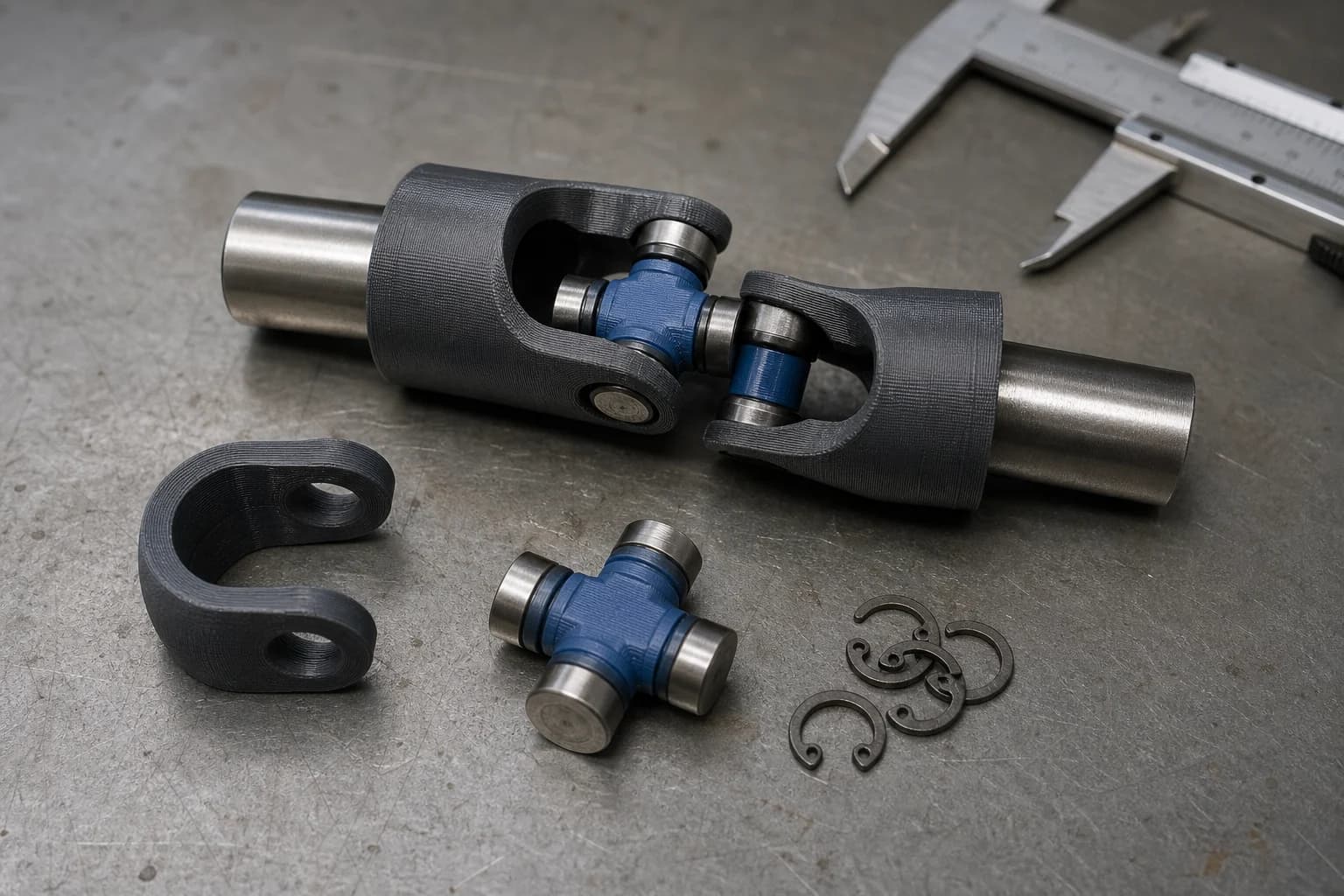
Model application study
A printed universal joint for an offset model mechanism
How a three-part PETG coupling uses open C-clip sockets to assemble around a cross and articulate through roughly 30 degrees.
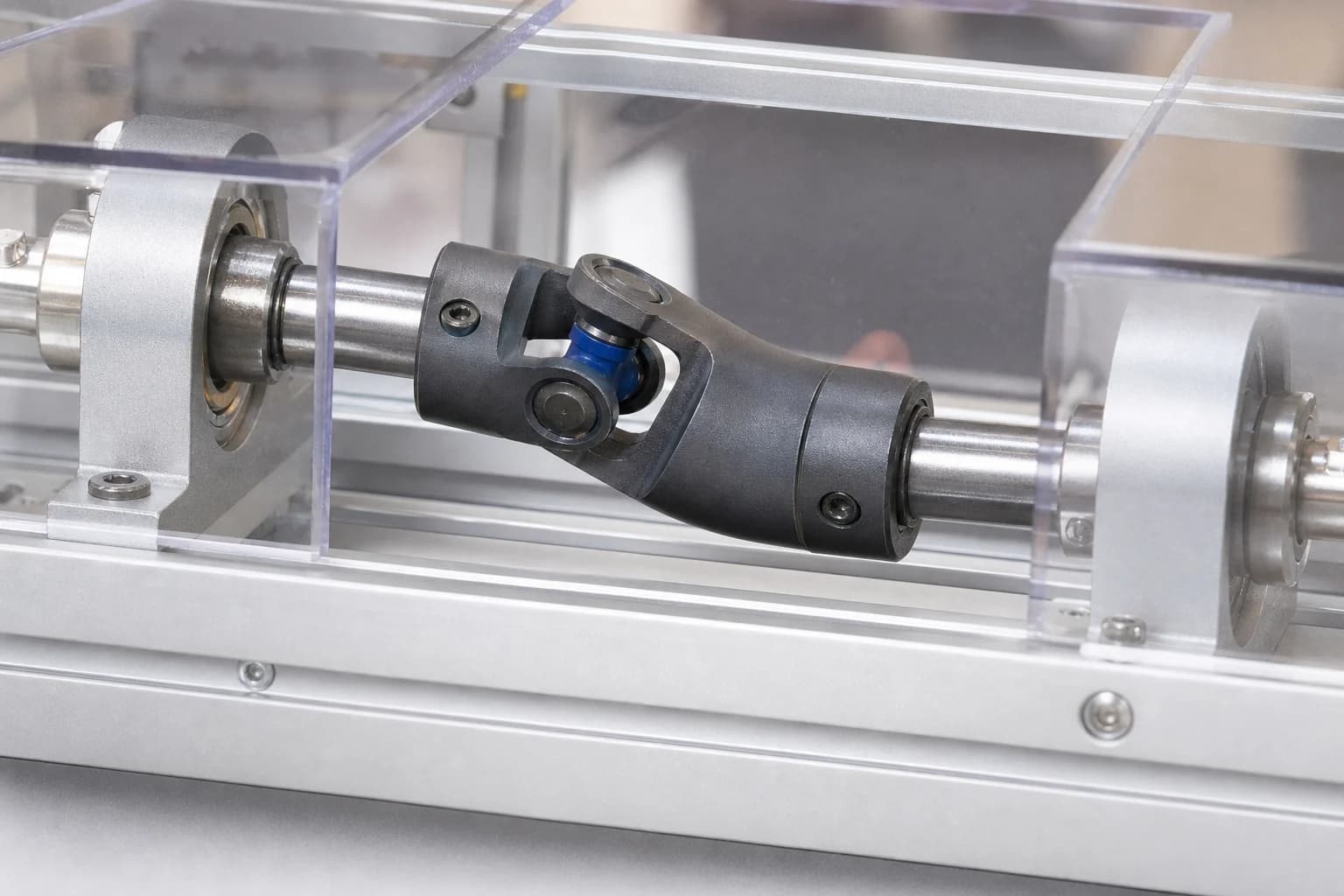
The application
Two low-speed model shafts meet at an angle that a rigid coupling cannot tolerate. A universal joint needs to assemble around perpendicular trunnions, but a closed printed socket would require the yoke arms to flex far enough to crack before the cross could enter.
Constraints
- The cross has perpendicular trunnion axes, so not all four pegs can be printed vertically in one orientation.
- The yoke sockets must open enough for assembly while retaining a 5mm trunnion afterwards.
- The joint is for alignment and low-speed model motion, not high torque or safety-critical transmission.
Process
01
Split the assembly
Two yokes and the cross share one kit plate. Each part can then stand in an orientation that avoids the impossible mid-air island of a one-piece joint.
02
Open the sockets
Each trunnion seats in an open C-clip with a mouth 0.6mm under its diameter and 0.35mm radial clearance, so PETG only has to spring slightly.
03
Assemble at 90 degrees
The cross clips into the first yoke and the second is fitted on the perpendicular axis. The resulting joint reaches about 30° before the yokes meet.
Design outcome
The published kit produces an understandable, serviceable coupling for a light mechanism. The open sockets avoid support roofs and make assembly possible, while the material choice is explicit about the flex needed at the yokes.
- Hub diameter
- 22mm
- Shaft bore
- 8mm
- Trunnion diameter
- 5mm
- Usable articulation
- About 30°